߲ݴý

Core Curriculum

The world doesn’t fit neatly into one area of study, and neither will your education.

With the Core Curriculum, you’ll choose courses that spark curiosity and challenge your perspective. This foundation empowers you to summon reason, communicate with power, and solve complex problems — setting you up for success no matter where you land.
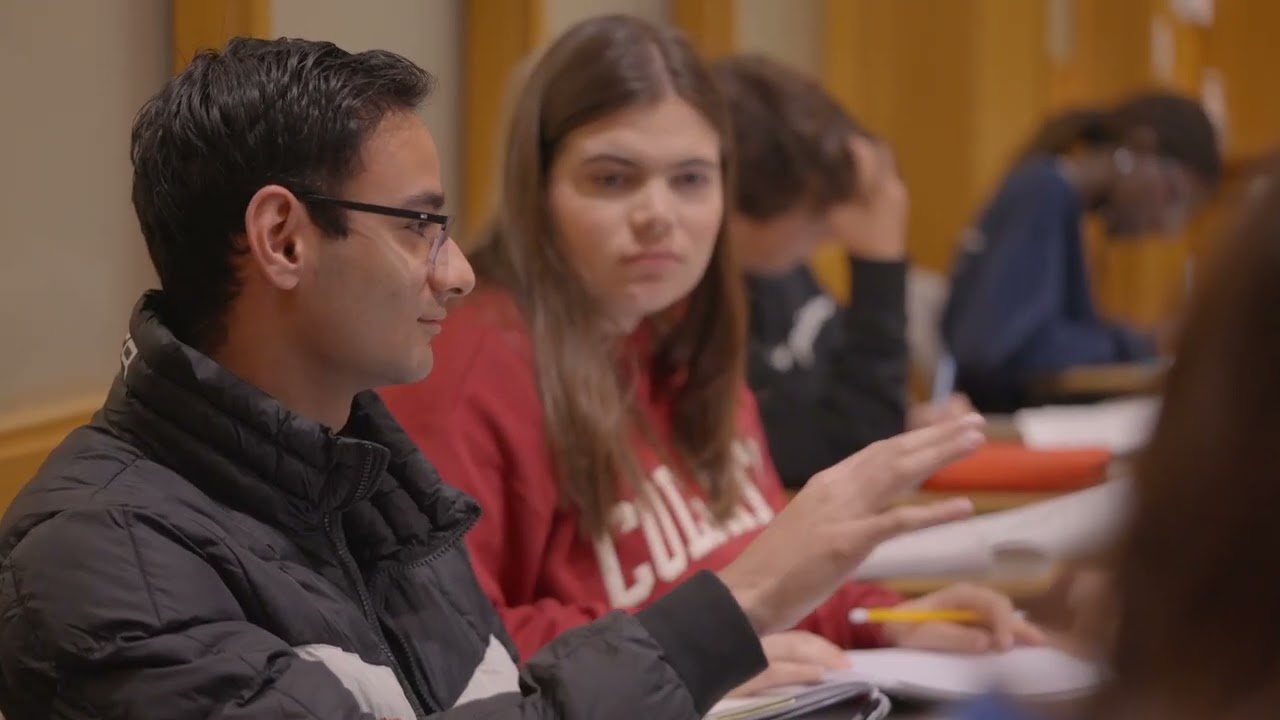
Discovery in the Core

Core courses sit outside specific academic disciplines, allowing students to explore themes and topics from a variety of angles and approaches. Topics collide — it’s where scientists analyze art, and mathematicians study ethics. This deliberate crossing of boundaries creates space to uncover interests you didn’t even know existed.

Video Poster

Liberal Arts Core Components

A small slice of your coursework, the Core takes students through an intellectual exploration of questions that every educated person will encounter at some point in their lives. 

First-Year Seminars & Living and Learning Workshops

First-Year Seminars (FSEMs) and the Living and Learning Workshop (LLW) introduce students to a range of liberal arts topics, skills, and ways of learning — connecting FSEM classes to residential life.

Core Communities

Core Communities helps students better understand how distinctive communities and cultures work. These multidisciplinary courses examine global phenomena such as capitalism, religions, colonialism, political ideologies, and new technologies, among many others. These courses can focus on a single nation or smaller, distinct communities.

Core Conversations

Core Conversations is a course focused on five shared texts — defined broadly to include diverse intellectual and creative expressions across cultures and time periods — to spark wide-ranging discussions grounded in the past and engaged with the present.

Core Sciences

Core Sciences investigates the scientific process and the relationship between science and society while engaging with the histories and social differences that can be and have been associated with science.

Liberal Arts Practices

Students also take courses emphasizing five Liberal Arts Practices: The Process of Writing, Quantitative and Algorithmic Reasoning, Language Study, Confronting Collective Challenges, and Artistic Practice and Interpretation.

Areas of Inquiry

Students take one course from each of three Areas of Inquiry: Human Thought and Expression, Social Relations, Institutions, and Agents, and Natural Sciences and Mathematics.

Physical Education & Wellness

Physical Education and Wellness promotes physical, mental, social, and environmental well-being. Students take two or more courses in the Division of Physical Education, Recreation, and Athletics.

Fulfilling the Core Requirements

Requirements

The following requirements apply to students who entered ߲ݴý in fall 2023 or later.

  • First-Year Seminars and the Living and Learning Workshop: First-year students must enroll in an FSEM and the Living and Learning Workshop.
  • Fulfilling the Core Components: must successfully complete Core Communities, Core Conversations, and Core Sciences.
  • Fulfilling the Liberal Arts Practices and Areas of Inquiry: students must successfully complete one course in each of the three Areas of Inquiry plus one course in each of the five Liberal Arts Practices. In total, these must come to at least seven courses, from at least six different departments or programs. Students may complete these requirements in any order, at any point during their progress toward a degree.
    • Although a course may carry multiple tags, a student may not fulfill multiple designations through a single course. The following exceptions apply:
      • Students may double-count their Process of Writing Practice course to also fulfill one Liberal Arts Practices or Areas of Inquiry requirement.
        • Students may double-count the FSEM to fulfill one Core Component or any Liberal Arts Practice or Area of Inquiry requirement except their Process of Writing course.
  • Fulfilling Physical Education and Wellness: Students are required to complete two units
  • Optional: Distinction Seminar in the Liberal Arts Core

The liberal arts model at ߲ݴý allows for exploration in the classroom, and you might find a love for a subject you never would have interacted with.

Katie Nettles ’26 Educational Studies and History

What Could Be On Your Schedule

Sciences

It’s a Dog’s Life
Language and Cognition
Life in the Universe: A Cosmic Perspective
The Hi(dden) story of Mathematics
Statistics in Real Life
The Good Life: Perspectives from Psychological Science
The Unreliable Internet
Foodwise

Communities

Russia at the Crossroads
The Middle East
Peru
California
Nigeria
Sri Lanka
Hispaniola (Haiti/Dominican Republic)
Rhythm and Blues

Areas of Inquiry

Human Thought & Expression

Latin American Modern and Contemporary Art
Video Arts
Chinese Medical Culture
Writers of Color Across the Globe: Literature and Decolonization
Muhammad and the Qur'an
Digital Music Studio
The World's Religions

Social Relations, Institutions & Agents

“Verifying You are Human”: The Future of a Category
Economics of Immigration
The American School
Diet & Disease: Gender, Health, and Nutrition in Society
Modern East Asia
Geopolitics
Introduction to Sociology
Women’s, Gender, and Sexuality Studies

Natural Sciences & Mathematics

Evolution, Ecology, and Diversity
Molecules, Cells, and Genes
Human Anatomy and Physiology
Inorganic Chemistry
Oceanography and the Environment
Number Theory and Mathematical Reasoning
Introduction to Neuroscience
Fundamental Physics II
Biological Psychology

Quantitative & Algorithmic Reasoning

Ecology
Stars, Galaxies, and the Universe
General Chemistry I
Data Structures and Algorithms
Introduction to Computer Systems
Economics of Education
Sustainable Earth
Calculus I
Introduction to Mechanics

The Process of Writing

The Rhetoric of Style
Digital Narrative Craft
Introductory Workshop in Creative Writing
Introduction to Film and Media Studies
Introduction to Philosophical Problems

Liberal Arts Practices

Arts

How to Buy a Work of Art
Sports and Spectacles in Ancient Greece and Rome
South Asian Fiction and Food
Applied Media: Podcasting: Audio and Video
Japan through Literature and Film
Introduction to Video Game Music
Scenic Design

Language Study

Arabic
Chinese
German
Japanese
Latin
Greek
Italian
French 
Spanish

Confronting Collective Challenges

Contemporary African American Playwrights
Introduction to Archaeology
Ethical Issues in Data Science
The Jazz Age
The City
Introduction to the History of Modern Medicine
Comparative Politics: Middle East
Politics and Moral Vision
Religion, Science, and Nature

Contact

Benjamin (Ben) Child
Associate Professor of English; University Professor, CORE Conversations
Teo Ballvé
Associate Professor of Peace and Conflict Studies and Geography; University Professor Core C&I
Jennifer Tomlinson
Associate Professor of Psychological and Brain Sciences; University Professor, Core Sciences
Peter Klepeis
Professor of Geography; University Professor, First Year Seminars
Anthony Chianese
Professor of Chemistry; Chair, Department of Chemistry
Jennifer (Jenn) Lutman
Director of University Writing; University Professor, Living and Learning Workshop