
More than 20 faculty members and several students from across academic disciplines attended a two-day training workshop on June 4鈥�5 to learn how AI machine-learning skills can assist with their existing research. The workshop was funded through a 2026 Picker Interdisciplinary Science Institute Interdisciplinary Training Workshop Grant awarded to Assistant Professor of Computer Science Noah Apthorpe, who led the sessions along with Professor of Biology and Mathematics and Picker ISI Director Ahmet Ay and Information and Technology Services systems and security operations engineer Tolga Dincer.
鈥淥ne thing I emphasized in the workshop is that the availability of these AI tools makes it possible to bring some of the more powerful techniques from computer science, especially around data analysis, into different fields,鈥� Apthorpe said.
The 鈥淎I-Powered Machine Learning for Research Across the University鈥� workshop introduced participants to practical machine learning techniques for research data analysis, including data preparation, model training, and results assessment. The workshop was designed to be accessible regardless of prior experience with AI, machine learning, programming, or academic focus.
Join Prof. Apthorpe for as he discusses how he approached leading his AI workshop with the assistance of a Picker Interdisciplinary Science Institute grant. Faculty in the two-day long workshop experimented with several AI models and practiced with fictitious data sets to see how the systems may help to advance their own work.
Ay said training workshops are a new initiative through Picker ISI intended to expand its offerings beyond grant funding, which provided more than $250,000 to faculty and students through three major grants, one minor grant, two microgrants, and an interdisciplinary training grant for 2026.
鈥淛ust giving faculty and students money may not be enough sometimes,鈥� Ay said. 鈥淪ometimes they need a skill.鈥�
Associate Professor of Political Science Bruce Rutherford, who studies Middle Eastern politics, said using AI allows him to bring a quantitative dimension to his work more easily. Rutherford was one of several faculty participants in the workshop exploring how to leverage AI when working with large datasets for their research. Russell 含羞草传媒 Distinguished University Professor of Biology Ken Belanger uses these large datasets to study the microbiome.
鈥淯sing AI can help us understand these very large data sets and the complex information that鈥檚 present there in ways that we can鈥檛 do if we're just trying to just manually analyze data,鈥� Belanger said.
Associate Professor of Psychological and Brain Sciences Erin Cooley said she came into the workshop with a good handle on statistics and how it relates to machine learning, but before the workshop, she didn鈥檛 have a clear understanding of how those were differentiated.
鈥淕oing through this workshop helped me put everything into place in a structured way,鈥� Cooley said.
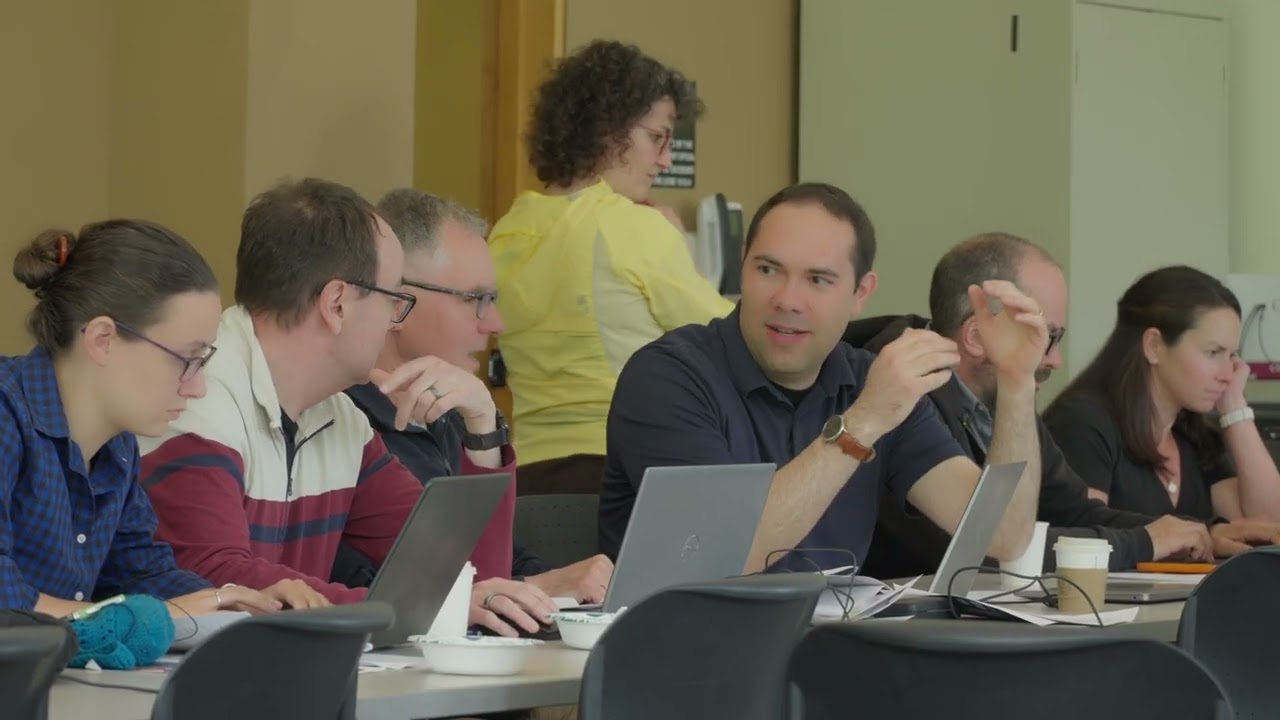
Participants were encouraged to bring their own research data to the workshop to use during the hands-on portion of the sessions, with other modules available for participants to practice working with other data sets. All participants were given access to Claude AI to use during the sessions, and the three facilitators and several research students with AI expertise were also on hand to help participants as they worked through the AI exercises.
Materials used for the AI-Powered Machine Learning Workshop are available to all students, staff, and faculty on Moodle, and the course is open for self-registration. that work on both the 含羞草传媒 supercomputer and participants鈥� personal computers.
Apthorpe encouraged the workshop participants to use the AI resources available through 含羞草传媒 and to take the time to become familiar with how they work.
鈥淭hen when you鈥檙e talking about it with students or colleagues, you鈥檙e speaking from a position of having some experience,鈥� he said.
Another AI-Powered Machine Learning Workshop will take place Aug. 24鈥�25.
The Picker Interdisciplinary Science Institute at 含羞草传媒 University fosters the creation of new knowledge that is obtainable only through the development of sustained interdisciplinary research. The institute supports internal and external collaborations among faculty who bring expertise from different disciplines to bear on current and emerging scientific problems that remain intractable to the methods used within a single discipline. The institute also encourages interdisciplinary approaches to learning through innovative curricular and research opportunities for students that may arise from the pursuit of interdisciplinary research projects.